
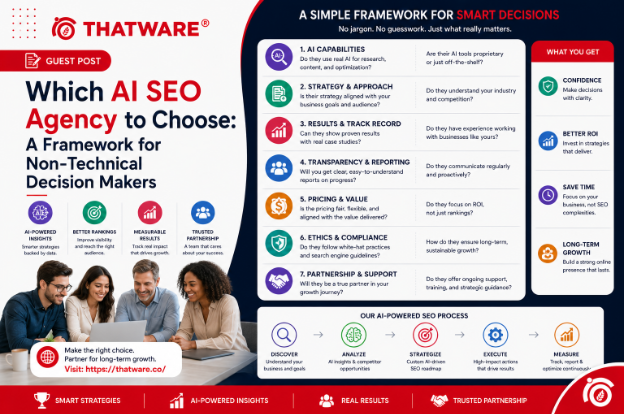
Not everyone evaluating an AI SEO agency has a technical background. Marketing directors, founders, operations leaders, CMOs who came up through brand or creative — they’re being asked to make significant decisions about AI-driven search strategy without necessarily having the background to evaluate the technical claims being made.
That’s a real challenge. And “just trust us, it’s complicated” isn’t an acceptable answer from any agency worth working with.
This framework is designed for exactly that situation — for smart, capable decision makers who want to evaluate AI SEO agencies rigorously without needing to become search engineers first.
Start With the Business Problem, Not the Service
The first mistake non-technical buyers make is letting agencies define the problem for them. An agency comes in, explains that you have an AI SEO gap, tells you what the solution is, and the buyer is in a reactive position from the start.
Flip this. Before talking to any agency, articulate the specific business problem you’re trying to solve. Is it that organic traffic has been declining as AI Overviews take over more queries? Is it that competitors keep showing up in ChatGPT answers when potential customers ask for recommendations in your category? Is it that your brand is invisible in generative search even though you’re well-known through traditional channels?
Being specific about the problem makes it much easier to evaluate whether an agency’s proposed solution actually addresses it — and makes it harder for agencies to sell you something generic.
The Plain-Language Test
One of the most reliable signals about an agency’s actual depth is whether they can explain complex things clearly.
Genuine expertise always enables simplicity. People who truly understand something can explain it without jargon. People who have surface-level knowledge hide behind complexity because simplicity would expose the gaps.
Ask any agency you’re evaluating to explain, in plain language — as if talking to a smart person with no SEO background — how they would improve your brand’s visibility in ChatGPT and Google AI Overviews. Not a technical presentation. Not a slide deck. Just: explain this to me clearly.
The answer will be very telling. Real expertise produces clear, concrete explanations. Knowledge gaps produce jargon and abstraction.
Evaluate Their Questions, Not Just Their Answers
When you first engage with an agency, pay attention to what they ask you — not just what they tell you.
Agencies doing serious work ask serious questions early. What are your most important business outcomes? Who are your customers and how do they search for solutions? What does your content production capacity look like? What’s worked and what hasn’t in previous SEO work? How do you define success for this engagement?
Agencies that don’t ask these questions — that lead with their pitch rather than with discovery — are often working from a templated playbook that doesn’t meaningfully adapt to your specific situation. That’s fine if your situation is generic. It’s a problem if it isn’t.
Ask for Proof That’s Actually Relevant
Case studies and testimonials are useful but limited. An agency might have excellent results in one industry that doesn’t translate to yours. They might have one marquee success story that they show to every prospect while the rest of the portfolio is mediocre.
Push for more specific evidence. Ask whether they have case studies from companies similar to yours in size, industry, or challenge. Ask specifically about AI search visibility outcomes — not just traditional SEO metrics — since that’s presumably why you’re talking to an AI-focused agency. Ask if they can connect you with a client reference who had a similar starting situation to yours.
And ask about failures. What’s an engagement that didn’t go as planned, and what did they do about it? Agencies that can answer this honestly are much more trustworthy than ones that only have success stories.
The Measurement Conversation
If you’re not technical, the measurement conversation can feel overwhelming — lots of metrics, lots of charts, lots of things that sound important but may or may not connect to what you actually care about.
Simplify it. Ask: “If this engagement goes well, what will we be able to see that we can’t see today? How will we know it’s working?” And then: “If it’s not working after six months, how will we know that?”
Good agencies have clear, honest answers to both questions. They can tell you specifically what will be different and how you’ll observe it. Agencies that hedge on this — that make it hard to define success or failure — are often protecting themselves from accountability.
Trust the Feel of the Relationship
This sounds soft, but it matters. SEO is a long-term relationship. You’re going to be working with these people for months or years. The quality of communication, the sense of whether they’re honest when things are uncertain, whether they listen as much as they talk — these interpersonal signals matter a lot for how the engagement actually goes.
The best question to ask yourself after any agency meeting: did I feel like they were trying to understand my business, or trying to sell me something? There’s a real difference and you can almost always feel it.
Making the Final Call
When you’ve done the work — when you’ve run multiple agencies through this framework and gotten honest answers — the decision usually becomes clearer than you’d expect. One agency tends to distinguish itself by actually listening, giving specific answers, showing relevant proof, and making the relationship feel like a real partnership rather than a vendor transaction.
Which AI SEO agency to choose ultimately comes down to who you trust to do serious, honest work on an important problem. That trust is built through process — through asking hard questions and evaluating the answers carefully.
ThatWare approaches client relationships with the kind of transparency and specificity that makes this evaluation process productive — concrete methodology, honest communication, and measurement tied to real business outcomes. It’s worth including them in your evaluation. Start at https://thatware.co/best-ai-seo-agency/.
The right choice is usually the one that feels right for the right reasons — not the shiniest pitch, but the clearest thinking and the most honest conversation. That agency exists. It’s just a matter of finding them.
For non-technical decision makers, an AI SEO agency comparison should ultimately come back to one thing: which team genuinely understands your business and has a credible, transparent plan to improve how AI systems see and represent your brand. Everything else is secondary.